
When can you burn brush in Ohio, and when is it banned?
Outside village and city limits, Ohio bans open burning from 6 a.m. to 6 p.m. Those months are March, April, May, October and November. In them you may burn only between 6 p.m. and 6 a.m. Inside a town, and in a ring around it, burning brush is not allowed at all. County bans stack on top.
What months and hours does Ohio ban open burning?
Ohio Revised Code 1503.18 covers open air fires outside any municipal corporation. It bans fires set to burn wood, brush, weeds, grass or rubbish. The window is 6 a.m. to 6 p.m. in March, April, May, October and November. Evening and overnight burning stays legal in those months. The other seven months carry no state hour limit.
Unincorporated means outside any village or city line. This rule is the one that covers farm ground, woodlots and rural home sites. The State Fire Marshal spells out that the ban takes in yard waste, trash and debris, even in a proper burn barrel. If you want the pile gone during daylight in those five months, brush removal that grinds the pile where it stands is the way around the calendar.
The reason is fire behavior. In spring the woods are full of dead grass and last year’s leaves before green up. Fall brings a fresh leaf drop. Warm, windy days push a small fire out of its ring fast.
The statute has one narrow exception. A fire in a plowed field, garden or public highway is allowed during those hours. It has to sit 200 feet or more from any woodland, brushland or dry grass field. Two more rules run all year. You need written permission to kindle a fire on land you do not own. You also have to clear the ground around the fire and stay until it is out.
Can you burn brush inside a city or village?
No. Ohio EPA treats every municipality as a restricted area, plus a buffer outside it. The buffer runs 1,000 feet past a town of 1,000 to 10,000 people, and one mile past a city of 10,000 or more. Yard waste and land clearing waste are not on the list of fires allowed there.
Mansfield has well over ten thousand people, so that restricted ring runs a full mile past the city line. What you can still have inside that ring is a recreational or cooking fire. It has to burn clean seasoned firewood, and it cannot be used to get rid of waste. The fuel area has to stay 3 feet or less across by 2 feet or less high. A ceremonial fire may run to 5 feet by 5 feet for up to three hours, with notice to Ohio EPA first.
Your city or township fire department can add rules of its own on top of that. Local ordinances cannot be looser than state law, only tighter.
What can rural land burn, and who has to be told?
Outside the restricted ring you may burn plant waste that grew on the property. The fire has to sit at least 1,000 feet from any inhabited building on other land. The material has to be stacked and dried. Pick a day when the smoke will carry off.
Size decides whether paperwork comes with it. A household yard waste pile bigger than 10 by 10 by 10 feet needs written notice to Ohio EPA first. A farm waste pile bigger than 20 feet across by 10 feet high needs the same notice. Notification goes in writing at least ten working days before you light it.
Land clearing waste is its own category, and it is the strict one. That means material that came off land being opened up for a house, a building or new farm ground. Burning it takes written permission from Ohio EPA plus an air curtain device or another accepted method. Ohio EPA says permission can take two weeks. Almost no landowner owns an air curtain burner.
Some materials are off limits everywhere in Ohio at any time. That list is food waste and garbage, dead animals, and anything containing rubber, grease or asphalt. Petroleum products count too, including tires and plastics. You also cannot burn during an air pollution alert, and you cannot burn waste that came from somewhere else. Ohio EPA’s example: a tree trimming crew cannot haul limbs elsewhere to burn them.
| Where | When | What the rule says | What you need |
|---|---|---|---|
| Unincorporated land, outside any village or city ring | March, April, May, October and November, 6 a.m. to 6 p.m. | No open air fire for wood, brush, weeds, grass or rubbish | Wait until after 6 p.m., or handle the brush another way |
| Unincorporated land, outside any village or city ring | Those five months from 6 p.m. to 6 a.m., plus the other seven months | Plant waste grown on the property may be burned, 1,000 feet from an inhabited building on other land | Written notice to Ohio EPA if the pile tops 10 by 10 by 10 feet |
| Unincorporated land, land clearing waste | Any time of year | Burning it calls for an air curtain device or another accepted method | Written permission from Ohio EPA before you light it |
| Inside a village or city, plus the buffer ring around it | Any time of year | Yard waste and land clearing waste may not be burned | A small recreational fire only: clean seasoned firewood, fuel area 3 feet by 2 feet or less |
How do you know if a burn ban is on right now?
The five month rule is always in force, so treat it as your baseline. On top of it, the State Fire Marshal can order a ban by county when drought or weather calls for one. A local fire code official can add a tighter ban at any time. Call your fire department before you light anything.
The Fire Marshal’s order can go statewide or cover a single region or county. In the 2024 drought the order tracked the U.S. Drought Monitor. Any county with even part of it rated in extreme or exceptional drought fell under the ban. The list was updated weekly. Separately, the governor may restrict or wipe out the 1503.18 burning times by executive order.
There is no single statewide map to check in one click. The reliable move is a call to your township or city fire department. That is what the state itself tells people to do. Your county sheriff or emergency management office will also know, and ODNR’s Division of Forestry takes questions at 877-247-8733.
What happens if you burn during the ban?
Violating the state burning law is a misdemeanor of the third degree. Ohio caps a third degree misdemeanor at sixty days in jail and a fine of up to five hundred dollars. Burning during a State Fire Marshal ban is a first degree misdemeanor instead. That one runs up to six months and up to one thousand dollars.
Ohio EPA enforces its own open burning rules separately, and says violations can carry substantial penalties. The bigger exposure is the fire itself. ODNR points out that you can be held liable for damage caused by a fire you kindle. Letting a fire spread into a structure, field or wood lot is its own fourth degree misdemeanor. A burn pile that walks into a fence row on a windy April day can cost more than any fine.
What can you do with the brush instead of burning it?
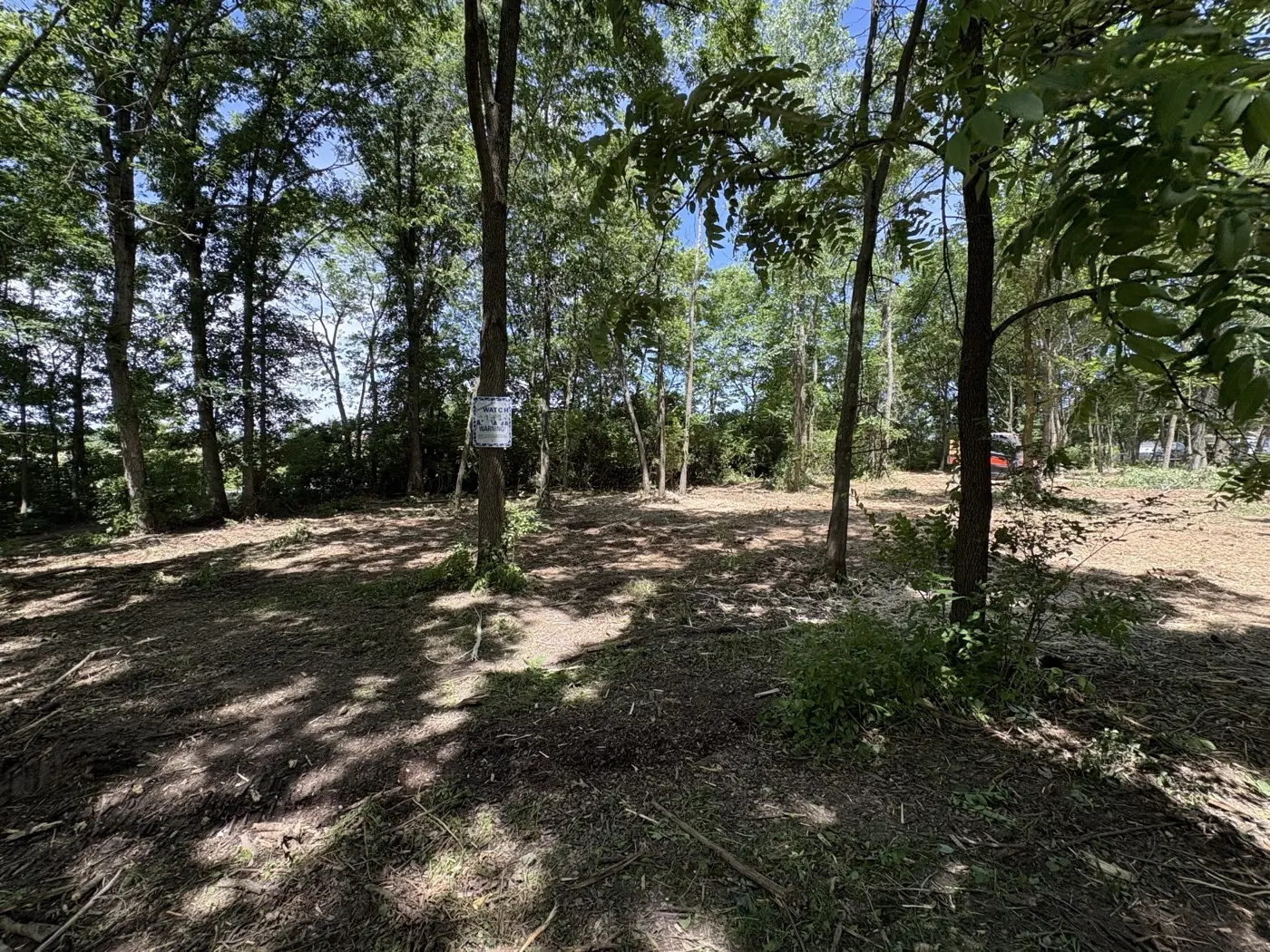
Grind it where it grew. Our tracked mulcher turns standing brush, briars, saplings and small trees into a chip layer right on the ground. Mulching is not a fire. The burn months and the Ohio EPA notice forms have nothing to attach to.
The machine takes stems up to about 6 inches across. Anything from 6 to 10 inches is slower but often workable when we pick and choose. Larger timber is tree service work. Stumps get ground 1 to 2 inches below grade so you can mow over them. Keeper trees are flagged and worked around. How the tracked mulcher works covers that in detail.
What you are left with is chips, not a burn scar. The layer holds down regrowth for a season or two. Then it breaks down into the soil and helps hold it against erosion. Roots and topsoil stay put, so the ground is stable the day the crew leaves. That matters on land clearing on a whole parcel as much as on a single brushy corner.
Two limits to know. Multiflora rose and bush honeysuckle resprout from the stump. The plan is to mulch once, then keep it in check with periodic brush hogging or spot treatment. A brush pile that is already cut is a different job than standing brush. We do not haul brush away. Whether that pile can be ground where it lies gets decided at the estimate.
| Option | Smoke | Permits and notice | What is left | Cost note |
|---|---|---|---|---|
| Burn pile | Days of it, and only a night window five months a year | Hour limits five months a year, plus Ohio EPA notice or permission | A burn scar, ash and the butts that would not burn | Cheap in dollars, expensive in time and risk |
| Cut and haul off | None on site | None to burn, but the material has to go somewhere that takes it | Bare, rutted ground where the piles and the truck sat | Truck time plus dump fees, and someone has to load it |
| Grinding in place | None | The open burning rules do not apply | An even chip layer over stable ground, roots and topsoil intact | Quoted by the job after an on site look |
Timing still matters, just not the way burn law timing does. Late summer through winter is prime clearing season here, and frozen or dry ground carries the machine cleanly. Cutting trees also runs into the October 1 to March 31 bat roost window, covered in the seasonal timing guide.
On price, regional market rates are the fair way to think about it. Typical residential mulching jobs land in the low thousands per acre, and light brush costs far less than dense regrowth. Our Ohio mulching cost guide walks through what moves the number.
If you have been waiting on a burn window that keeps closing, there is another way. We work out of Mansfield and cover 75 miles across north central Ohio, doing brush removal that leaves chips instead of a burn scar. Call or text (614) 359-8762, or tell us about your property for a free written estimate.