
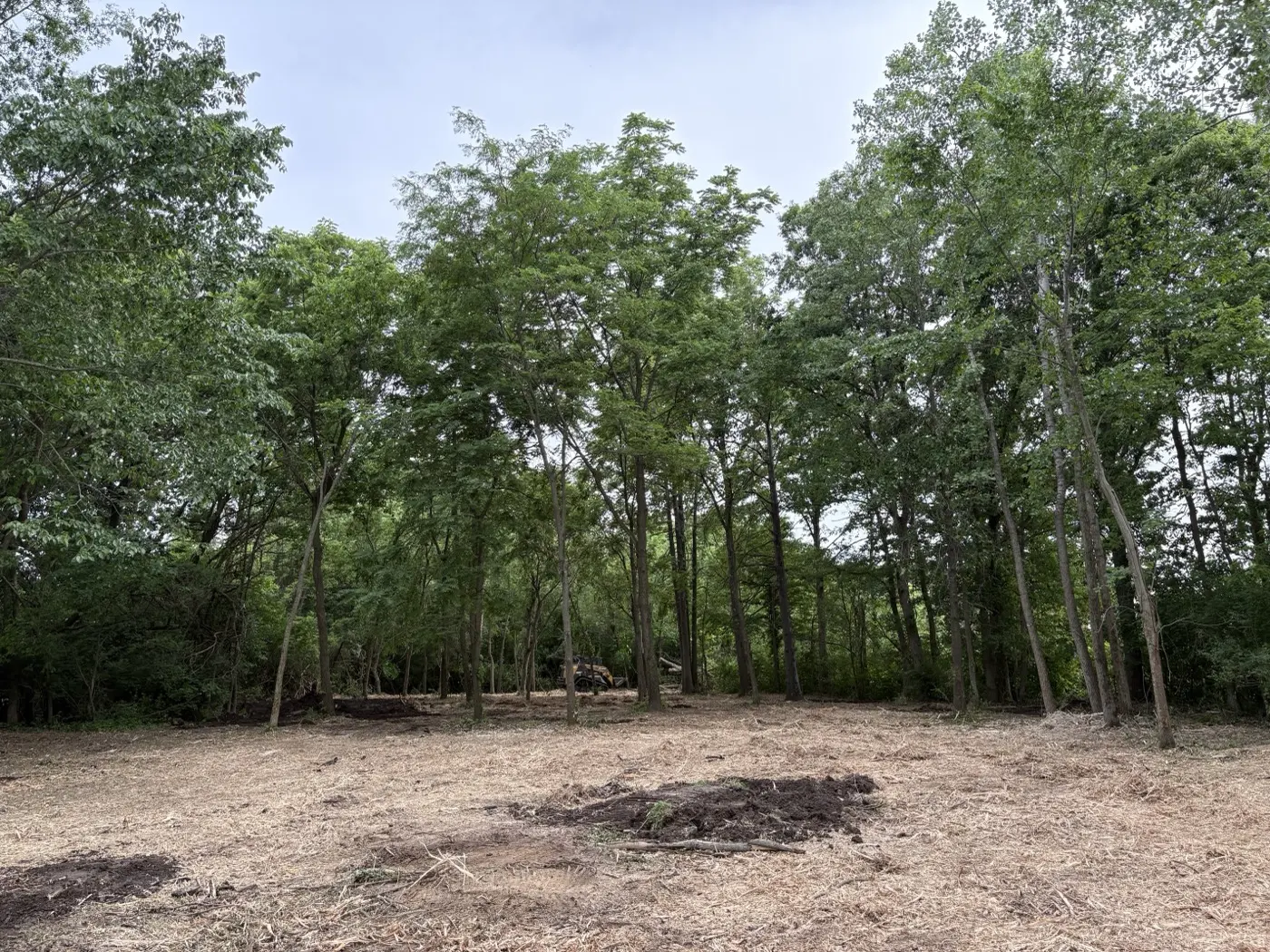
When is the best time of year to clear land in Ohio?
October through March. That is not a preference, it is where three separate calendars agree: the wildlife window that governs tree cutting, the ground conditions that decide whether equipment ruts your soil, and the scheduling reality of a trade everyone calls in April. Plan a clearing project backward from that window and everything about it gets easier and cheaper.
Our forestry mulching calendar fills exactly this way every year, so this guide is also fair warning: fall callers get the good slots.
The bat rule sets the hard boundary
Ohio’s tree-clearing season has a legal edge to it. The endangered Indiana bat and northern long-eared bat roost in trees from spring through fall, and projects with federal funding or federal permits in Ohio are restricted to cutting trees between October 1 and March 31. On private land ODNR discourages warm-season tree cutting for the same reason, and its wildlife staff have said plainly that killing roosting bats in a summer cut can bring enforcement.
For a landowner the practical read is simple: brush and field growth can be worked most of the year, but anything with real trees in it belongs in the dormant window. It is the safe answer biologically and the clean answer legally.
Frozen ground is a feature, not an obstacle
The forestry world treats frozen or snow-covered ground as a best practice for heavy equipment, because it minimizes rutting, erosion, and sediment runoff. The soil science backs it up: soil compacts worst when it is wet, around the moisture level Ohio ground holds all spring, because the water lubricates the soil particles and lets them squeeze tight under weight. Compacted soil then fights everything you plant into it, roots cannot push through pores that no longer exist.
Ohio adds its own twist: our soils run heavy with clay, and clay worked wet smears and forms clods that can persist through the whole growing season. Every farmer who has ever mudded in a field knows the price. The same physics applies to a clearing machine, which is why we schedule wet-prone parcels for frozen or dry spells instead of forcing them.
The off-season is also just cheaper and faster
Spring and summer are the busy season for brush and clearing work, and busy seasons price and schedule like busy seasons. Cost guides say it outright: expect to pay more in spring and summer. Book the same job for January and the calendar is open, the ground is at its best, and the growth is dormant, which means everything cut stays cut until spring instead of answering back in three weeks.
There is a presentation bonus too. Land cleared in winter greens up as finished ground in April. Land cleared in June spends your best months looking mid-project.
What the mulch layer does while you wait for spring
A mulched clearing job does not leave bare dirt waiting for weather. The chip layer stays on the ground and works: it takes the rain impact instead of the soil, holds moisture, buffers temperature, and leans on regrowth while it decomposes. Equipment makers pitch those benefits, and the university mulch science agrees on every one of them, protection from erosion, temperature regulation, weed suppression.
Breakdown is gradual, months for fine chips, up to a couple of years for coarse hardwood, faster where it is warm and damp. By the time the layer thins, the grass or seedlings you wanted have the ground.
The season is finite and the good weeks go first. If a clearing project is anywhere in your plans, walk it with us in the fall, the estimate is free, and January does the rest.