What size trees can a forestry mulcher handle?
A forestry mulcher earns its living on brush and trees up to about 6 inches in diameter. That is the sweet spot where the machine grinds standing growth into chips in one continuous pass. From 6 to 10 inches the work is still doable but slows down and gets selective. Past 10 to 12 inches, grinding stops making sense and a saw or a tree service becomes the honest recommendation.
Those are the numbers we quote by at E&S Forestry, and this guide explains what they mean on real Ohio ground.
The 6-inch sweet spot, and why it exists
A drum mulcher grinds by feeding wood against carbide teeth. Small stems feed fast, so brush, briars, and saplings disappear at walking pace. Every added inch of diameter multiplies the wood the head has to chew, which costs time, fuel, and tooth wear. Around 6 inches, the machine goes from clearing to working. Past 10, it goes from working to grinding away money you should not spend.
Density compounds the effect. An acre of scattered 4-inch saplings clears far faster than an acre of the same stems packed in a thicket with multiflora rose laced through them. That is why honest quotes come from walking the ground, and why the per-acre ranges in our Ohio cost guide are ranges.
| Stem size | How the mulcher handles it | What it means for your job |
|---|---|---|
| Brush and saplings under 3 in. | Continuous pass, fast | Cheapest per acre, quick turnaround |
| 3 – 6 in. | Standard mulching work | The core of most clearing jobs |
| 6 – 10 in. | Selective, slower, tree by tree | Doable, priced by machine time |
| 10 in. and up | Not mulcher work | Fell first, hybrid job, or tree service |
What happens with the 6-to-10-inch trees
Trees in this range get individual treatment. The operator sizes each one up, takes it in sections, and feeds it deliberately rather than sweeping through. It works, and on most properties there are few enough of these stems that it barely moves the price. When a parcel has hundreds of them, it is really young woods rather than overgrown ground, and we will price it and phase it accordingly, or tell you a different method wins.
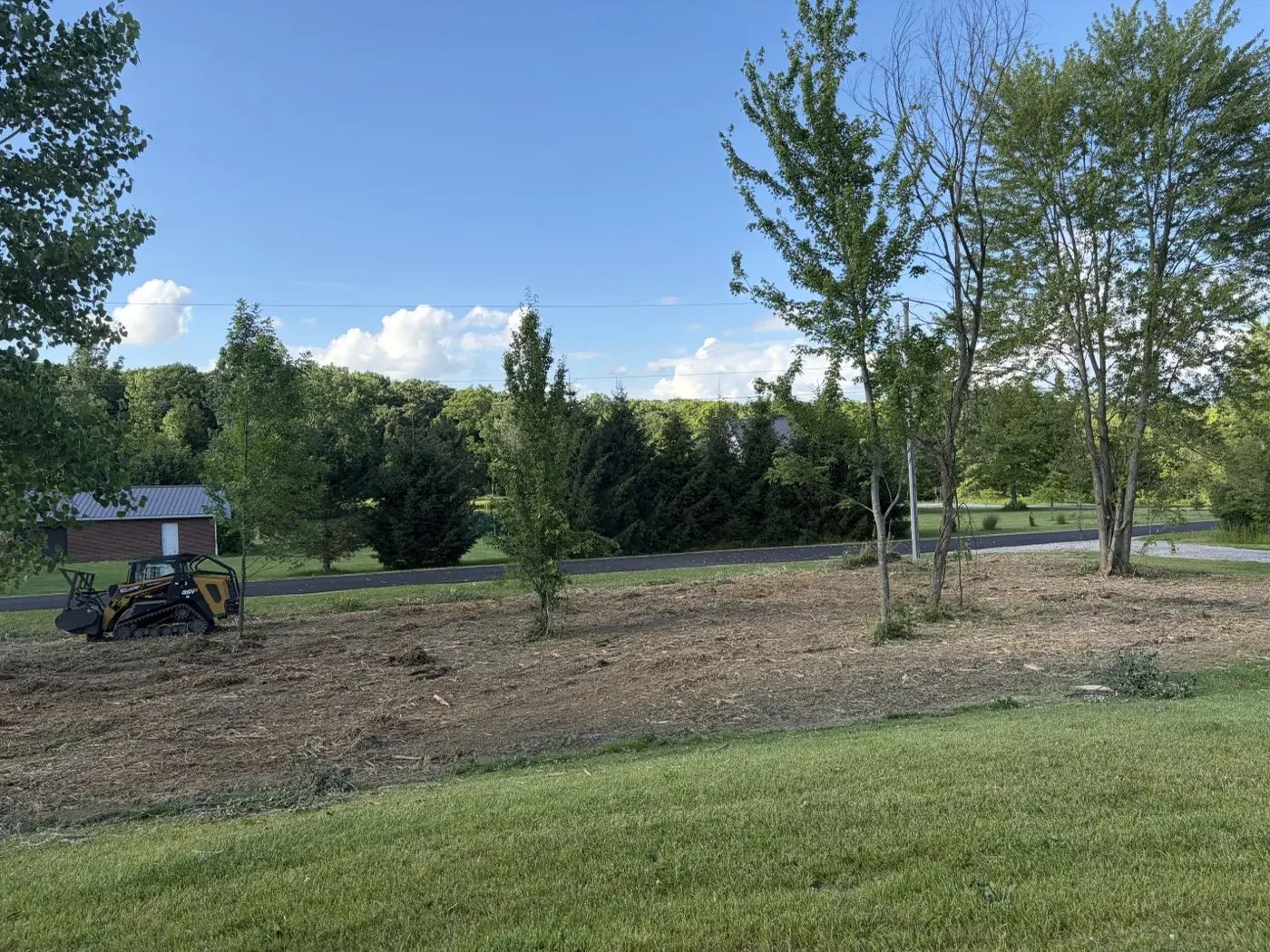
The same judgment applies to what you keep. Most jobs we run are selective: the mature oaks, maples, and cherries stay, everything under and around them goes. A mulcher is precise enough to clean the understory out of a woods without marking the keeper trunks, which is something no dozer can claim.
Stumps: ground down, not pulled out
A common surprise for first-time customers: mulching does not extract stumps. The head grinds each stump to roughly an inch or two below grade, low enough to mow over and let rot finish the job underground. For pasture, trails, food plots, and views, that is exactly right, and it is why mulched ground stays stable instead of turning into a field of root-ball craters.
If your project truly needs stumps out of the ground, a building pad or a driveway cut, that is excavator work, and we will say so at the estimate. The comparison post on mulching vs. traditional clearing covers that boundary in detail.
The Ohio wrinkle: dead ash
North central Ohio woodlots are full of standing dead ash killed by the emerald ash borer, and dead ash is the one tree category where size limits get overridden by safety. Dead ash sheds limbs and snaps unpredictably, so big dead ash near houses, drives, and work areas belongs to a tree service with rigging, regardless of diameter. What we handle is everything the ash borer mess leaves at ground level: the tops, the brush, and the tangle that grew up through the light gap. Plenty of our woods cleanup work starts exactly there.
Frequently asked questions
What is the maximum tree size for a forestry mulcher?
Most compact-machine mulchers work efficiently up to about 6 inches of trunk diameter, handle 6 to 10 inches selectively at a slower pace, and should not be pointed at much beyond that. Bigger machines stretch the range, but past roughly 10 to 12 inches, felling first or calling a tree service beats grinding.
Can a forestry mulcher grind small stumps?
Yes. A mulching head grinds stumps down to roughly an inch or two below grade, which is low enough to mow over. That is different from a dedicated stump grinder or excavator, which remove the stump and root crown entirely. For most field and trail uses, ground-flush is all you need.
How many acres can a forestry mulcher do in a day?
Half an acre to two acres per day is the realistic range. Light brush is fast, and dense growth with bigger stems is slow. Tree size is the single biggest variable: every extra inch of diameter costs machine time.
Will mulching hurt the big trees I want to keep?
Not when it is done selectively. The head works close to keeper trunks without digging or pushing, so bark and roots stay intact. Flag the trees you want saved and a careful operator clears everything around them.
What happens to trees that are too big to mulch?
They either stay, get worked around, or come down by chainsaw and get handled as a hybrid job. Standing dead trees big enough to be hazardous, like the dead ash all over Ohio, belong to a tree service with the rigging to drop them safely.
Not sure which side of the line your trees are on?
Neither is anyone else until the ground gets walked. If you are within 30 miles of Mansfield, request a free estimate or call (614) 359-8762. We will look at what is growing, tell you what the mulcher handles, and be straight about anything that needs a different tool.