
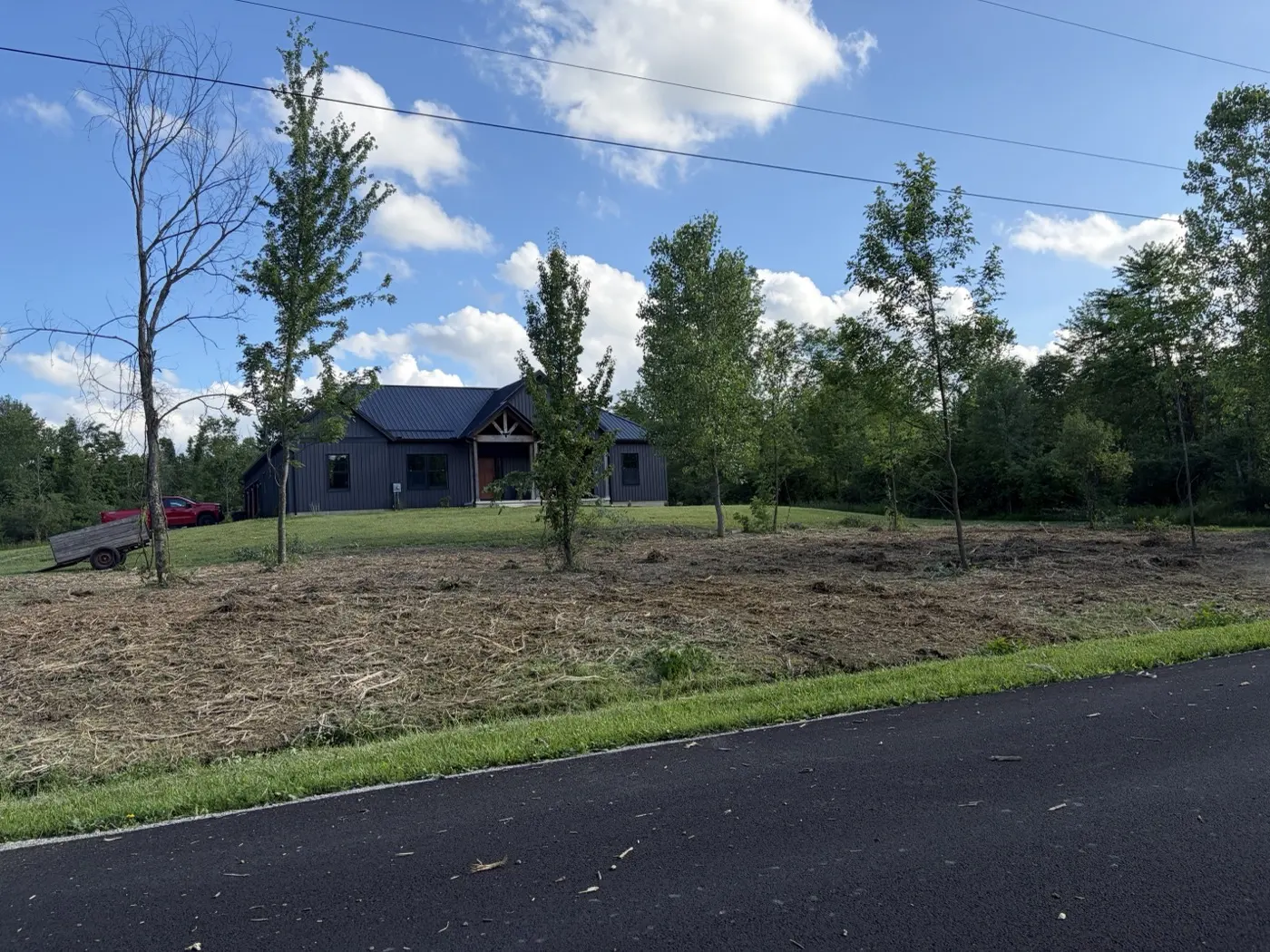
Forestry mulching vs. traditional land clearing: which one does your property need?
For most overgrown Ohio properties, forestry mulching is the cheaper, faster, gentler choice: one machine grinds brush and small trees into mulch that stays on site, typically for $1,500 to $3,500 per acre. Traditional excavator clearing costs more but does what mulching cannot: pull stumps, grub roots, and prepare ground for construction. The right answer depends on what the land is for.
Here is the full comparison, including the cases where we would honestly tell you not to hire us.
The two methods, in plain terms
Forestry mulching is a tracked machine with a grinding head that turns standing vegetation into wood chips where it stands. Nothing is dug, piled, hauled, or burned. The finished ground is covered in mulch, stumps are ground to an inch or two below grade, and the root mat stays in the soil. It is what we run at E&S Forestry, and it is built for brush, thickets, and trees up to about six inches through.
Traditional land clearing is dirt work. An excavator or dozer pushes over and digs out vegetation, stumps and all, then the debris gets piled and burned or loaded and hauled. It leaves bare, workable earth, which is exactly what you want under a foundation and exactly what you do not want on a hillside pasture.
Side by side: cost, stumps, mess, and time
| Factor | Forestry mulching | Traditional clearing |
|---|---|---|
| Typical Ohio cost per acre | $1,500 – $3,500 | $2,000 – $6,000+ |
| Debris | None. Mulch stays on site | Burn piles or $500 – $2,000+ hauling |
| Stumps | Ground 1–2 in. below grade, roots stay | Fully extracted, roots grubbed |
| Soil and erosion | Root mat intact, chips cover the soil | Bare dirt, needs silt fence and seeding |
| Best tree size | Brush to ~6 in., selective above that | Any size, including mature timber |
| Typical timeline | 1 machine, 1–3 days for most lots | Multiple machines, often 2–5 days |
| Finished look | Park-like, mulched, walkable | Stripped, ready for grading |
The cost rows deserve one honest caveat: on genuinely heavy timber, mulching loses its edge. Grinding big wood is slow, and past a certain stem size a saw and an excavator are simply the right tools.
When forestry mulching is the right call
Choose mulching when the goal is usable ground rather than buildable ground. That covers most of what north central Ohio landowners actually need: pasture taken back from multiflora rose, field edges pushed back, woods cleaned of underbrush, fence rows opened, trails cut, views restored, and just-purchased acreage made walkable.
Mulching also wins wherever the ground itself is fragile. On slopes, along creeks, and on the wet clay that covers most of this region, keeping the root mat intact is the difference between a stable field and a gullied one. The chip layer feeds the soil, smothers the first flush of regrowth, and lets grass come back through.
And it wins on neighbors. No burn piles smoking for a week, no convoy of debris trucks, no scraped moonscape next to their property line.
When traditional clearing earns its cost
Hire dirt work when something is getting built. A house pad, pole barn footprint, driveway cut, septic field, or pond all need stumps and roots out of the ground and grade established. Mulching can and often should do the first pass, clearing the vegetation so the excavator works faster and cheaper, but the excavation itself is a different trade with different machines.
The same goes for mature timber. A stand of 18-inch oaks is logging or tree service work, not mulcher work. We say this plainly on our land clearing page because it is the most common place land clearing quotes go wrong: the wrong machine grinding away expensive hours at a job the right machine would finish before lunch.
The hybrid approach most projects actually use
Real projects rarely pick just one. The pattern that saves money: mulch the whole parcel first to make it visible and workable, then bring excavation in for only the footprint that truly needs it. You pay mulching rates for the 90 percent of the ground that just needed vegetation gone, and excavation rates only where foundations and grades demand it.
If you are weighing the budget side in more detail, our Ohio forestry mulching cost guide breaks down per-acre pricing by growth type.
Frequently asked questions
Is forestry mulching cheaper than traditional land clearing?
Usually, yes, for brush and small trees. Mulching typically runs $1,500 to $3,500 per acre in Ohio while conventional clear-and-haul work commonly runs $2,000 to $6,000 or more once debris removal is counted. The gap comes from hauling: mulch stays on site, so there are no trucks, dump fees, or burn piles.
Can a forestry mulcher clear land the same as an excavator?
Not identically. A mulcher grinds standing vegetation into chips and leaves roots and ground stumps in place. An excavator can pull stumps, grub roots, and reshape ground. For usable open land, mulching is enough. For a building pad or full grubbing, you need dirt work.
What are the downsides of forestry mulching?
Stumps stay in the ground, ground an inch or two below grade rather than extracted. Very large trees are outside a mulcher’s range. And regrowth from aggressive roots needs a follow-up mow or spot treatment. For construction pads, those limits matter. For fields, trails, and views, they usually do not.
Does land clearing cause erosion problems in Ohio?
Bare-dirt clearing can. Ohio clay sheds water fast once the vegetation and root mat are stripped, which is why scraped sites need silt fence and seeding. Mulched clearing leaves the root mat intact under a chip layer, so the soil stays covered and stable from day one.
Which method is faster?
Mulching, in most residential cases. One machine mulches half an acre to two acres per day with no debris handling afterward. Conventional clearing involves cutting, piling, hauling or burning, and usually more than one machine, which stretches most jobs across more days.
Talk it through before you commit a budget
The cheapest clearing project is the one scoped with the right tool from the start. If your ground is within 30 miles of Mansfield, get a free estimate from E&S Forestry. We will walk it with you, tell you which parts are mulcher work, and point you to the right trade for anything that is not.