
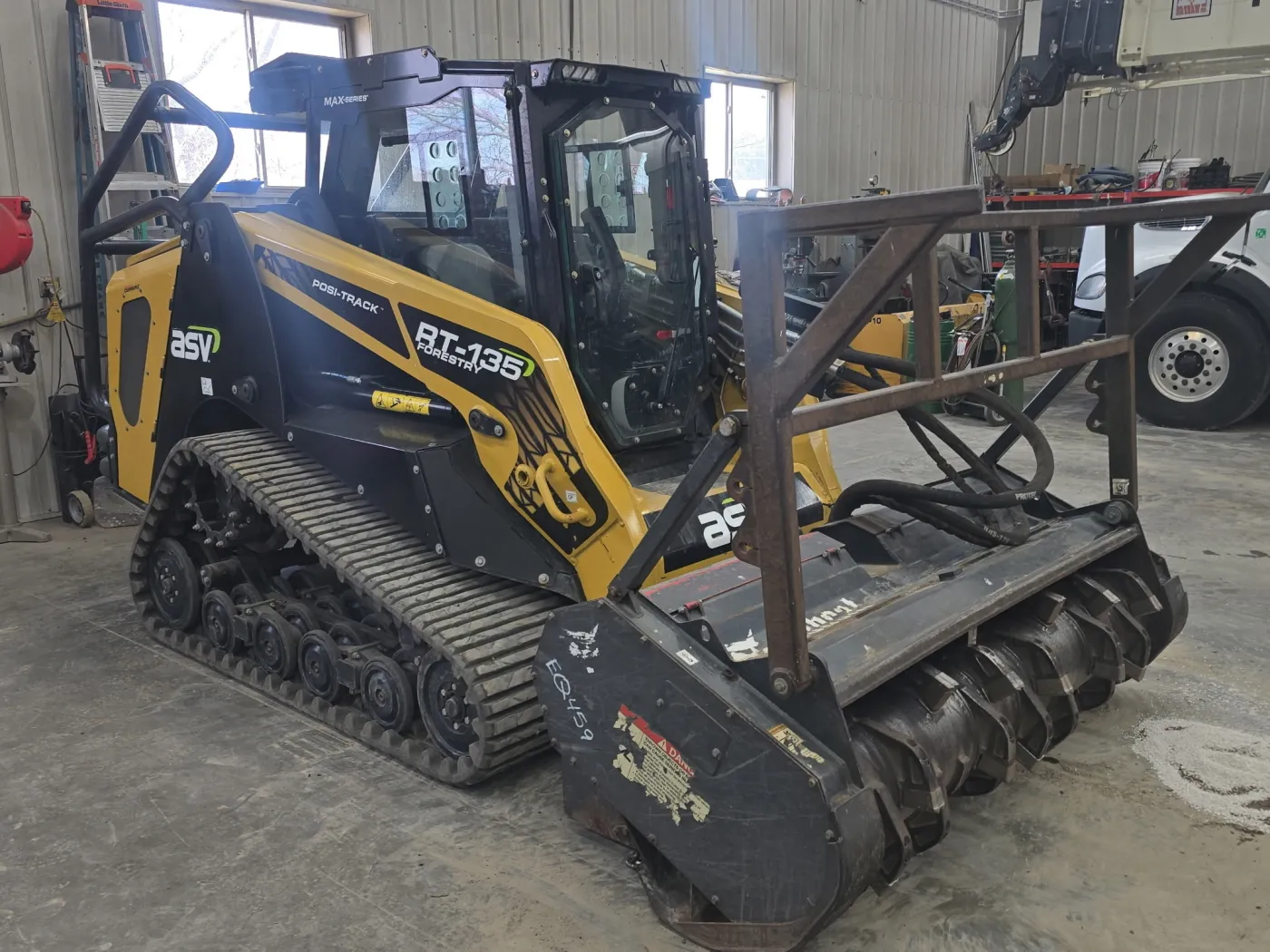
Should you rent a forestry mulcher or hire a crew?
Renting a forestry mulcher can work if you already run a skid steer and the brush is light and open. Hiring wins when the growth is dense, trees run near 6 inches, or the ground is steep. It also wins when keeper trees, fences or buildings sit close, or when you have no machine of your own.
If the second half sounds like your land, it may be time to hire a forestry mulching crew. If the first half fits, a forestry mulcher rental can be a fair choice. Every rental figure below is a yard’s own posted rate or term.
When does renting a forestry mulcher make sense?
Renting a forestry mulcher makes sense for someone who already runs a skid steer or track loader. It fits light, open brush on your own ground, with time to spare. Cat Rentals frames renting as the choice for people who already have operating experience. That is a fair line to draw.
Cat lists real reasons to rent. It says renting lets you avoid hourly contractor rates by using your own labor. It also says you can work on your own timeline, without waiting through peak contractor demand.
Cat notes that forestry mulching takes one machine and one person in the seat. Its mulcher attachments turn skid steers and track loaders into mulching machines. If your own machine can run a mulching head, you may only need to rent the head.
What does a forestry mulcher rental cost?
Forestry mulcher rental rates vary by yard, and none below is an Ohio average. A middle Tennessee yard posts a skid steer and forestry mulcher bundle at $1,197 a day. A Michigan dealer’s rate table lists a low-flow forestry package at $1,500 a day and $5,000 a week.
| Rental | Where it is posted | Posted rate |
|---|---|---|
| Skid steer and forestry mulcher bundle, one day | A middle Tennessee rental yard | $1,197 |
| Same bundle, weekend special | A middle Tennessee rental yard | $1,897 |
| Same bundle, one week | A middle Tennessee rental yard | $3,897 |
| Same bundle, one month | A middle Tennessee rental yard | $9,989 |
| Low-flow forestry package, one day | A Michigan equipment dealer | $1,500 |
| Same package, one week | A Michigan equipment dealer | $5,000 |
Longer terms bring the daily cost down at both. A week at the Tennessee yard costs a little more than three days at its daily rate, and the Michigan week costs about three and a third days. Rates vary by yard, so call a rental yard near you for its current numbers.
What does the daily rate leave out?
A forestry mulcher rental’s daily rate buys machine time, and only so much of it. At the middle Tennessee yard, a day means at most 8 hours of machine time, and a week means 40. The damage waiver is not insurance. Delivery, fuel and your learning time are yours to plan for.
Hours past the limit add a prorated hourly charge there. The rental day also starts at 9:00 AM, no matter when the machine arrives. Every hour you spend learning the controls comes out of the same 8.
That yard’s optional damage waiver excludes claims for damage to other people or property while you use the machine. Hoses, couplings, some attachments and tracks thrown through operator error are not covered.
The yard spells out what operator error means for a thrown track. Steep side slopes, uneven terrain, driving over stumps or rocks and striking trees all count. The renter then pays for the service call, the track and undercarriage damage, and the downtime.
The machine goes back clean, too. Packed dirt in the tracks never counts as clean there and must be hosed out. A machine returned very dirty draws a cleaning fee based on the time it takes. The yard does sell prepaid cleaning for a small fee, and it offers free reschedules.
Will a mulcher head fit the skid steer you already own?
A mulching head fits your skid steer only if it matches the machine’s hydraulic flow. The Michigan dealer rents separate low-flow and high-flow mulcher packages. Fecon, a mulching head maker, lists its standard flow head for carriers from 17 gallons per minute. Its high flow head needs 30 to 50 gallons per minute.
Fecon’s own page puts it plainly: a high flow head on a standard flow carrier will not perform. So the head that fits a rental yard’s machine may not fit yours.
Tree size ties back to flow. Fecon rates its standard flow head for trees up to 5 inches in diameter. Its high flow head mulches 4 to 6 inch trees quickly, depending on the carrier’s horsepower. Our guide to what size trees a forestry mulcher can handle covers the rest.
If your machine cannot run a head, the other route is a dedicated mulcher. The Fecon FTX150 that the Michigan dealer rents weighs 17,250 pounds and makes 155 horsepower.
Flying debris is the safety story both rental sources tell. The Tennessee yard fits every skid steer with a 1/2-inch polycarbonate safety door. Cat lists hydraulic mulching doors that prevent flying debris among its attachments’ safety features.
How do renting and hiring compare side by side?
Renting buys machine time and leaves the risk and the cleanup with you. Hiring buys a finished job at a written price. The table lines the two up. The renting column uses one Tennessee yard’s posted terms, and the hiring column is how our crew works.
| Question | Renting a mulcher | Hiring a crew |
|---|---|---|
| What you pay for | Machine time by the day, weekend, week or month | One written price for the job, after an on-site look |
| Who is in the seat | You | Our four-man, family-run crew |
| Hours you get | At most 8 machine hours a day or 40 a week; extra hours add a prorated charge | A timeline in writing; roughly half an acre to two acres a day |
| Damage and liability | The waiver is not insurance and excludes damage to other people or property | We are an insured LLC |
| If the job runs long or it rains | More time means more rental; the yard offers free reschedules | The written price holds unless the scope changes |
| Cleanup and return | The machine goes back clean; packed dirt in the tracks never counts | Nothing to return or wash |
| What is left behind | Depends on the head and your hours in the seat | A chip layer, stumps 1 to 2 inches below grade, keeper trees standing |
What do you get when you hire a forestry mulching crew?
Hiring our crew gets you a finished job at a written price. Our tracked mulcher grinds brush, briars, saplings and trees up to about 6 inches into chips where they stood. It covers roughly half an acre to two acres a day, depending on density. Nothing is burned, piled or hauled off.
Stumps end 1 to 2 inches below grade, so the ground can be mowed. Roots and topsoil stay in place, so cleared ground is stable the day the crew leaves. Keeper trees are flagged before work starts, and the crew works around them.
Fences get the same care. Where a fence is coming out anyway, the mulcher works the growth off the wire. Where the fence stays, the crew cuts by hand with chainsaws. The machine never runs into a fence that is staying.
The tracked machine handles slopes, soft spots and steep ground better than wheeled gear. Most residential jobs run one to three days. The same machine does our land clearing work.
Typical residential mulching jobs land in the low thousands per acre, and light brush costs far less than dense regrowth. The details are in what forestry mulching costs in Ohio. We give a free written estimate after an on-site look, and the price and timeline hold unless the scope changes. We are an insured LLC, a four-man, family-run crew with 5 years of combined experience.
Should you rent a brush cutter instead of a mulcher?
For grass, weeds and soft brush, a brush cutter can do the job, and it rents for less. The middle Tennessee yard posts a walk-behind brush cutter at $99 a day. Its skid steer and brush cutter bundle is $634 a day. Thick woody stems and small trees are mulcher work.
A field that only needs mowing is a brush hogging job. A brush hog is a heavy rotary cutter, and our crew runs one alongside the tracked mulcher. Once saplings grow thick and woody, the job moves to the mulcher. For the mowing side of the budget, see what brush hogging costs in Ohio.
Which jobs point to renting, and which point to hiring?
Dense regrowth, trees near 6 inches, slopes and selective work point to hiring. So do fences and buildings close to the work, or having no machine of your own. A light, open, repeat job on your own ground, with your own machine and experience, can point to renting.
Trees near 6 inches sit past what Fecon rates its standard flow head for. Steep side slopes can turn a thrown track into the renter’s bill at the Tennessee yard. A fence, shed or barn near the work matters because the waiver excludes damage to property. Working close to keeper trees is where time in the seat shows.
Rented or hired, read up on who to call before clearing starts. If your land falls on the hiring side, that is forestry mulching with a tracked machine. Call or text (614) 359-8762, or ask for a free written estimate to set beside the rental math. Our crew is based in Mansfield and works up to 75 miles out across north central Ohio.