
Is poison hemlock a noxious weed in Ohio, and how do you get rid of it?
Yes. Poison hemlock (Conium maculatum) is on Ohio’s prohibited noxious weed list, Ohio Administrative Code 901:5-37-01. The version effective February 16, 2025 names 31 plants. Township trustees can require it cut. Mowing works when timed after the plants bolt and before they bloom. Plan on more than one season, because the seed lasts for years.
In summer it stands out as a tall weed with purple-spotted stems and white umbrella flowers. It turns up along fence rows, roadsides and pastures. In fall it is easy to miss, because the plant sits low as a green rosette until spring.
We clear brush and mow overgrown ground across north central Ohio, out of Mansfield. Our brush hogging work uses a heavy rotary cutter, a shrouded mower, on tall weeds and light brush. With poison hemlock, timing decides the result. OSU Extension puts it in three words: timing is everything.
How do you identify poison hemlock?
Poison hemlock is a two-year plant. The first year it grows as a low, thick rosette of finely cut leaves. The second year it bolts into a stalk that can reach 6 to 10 feet. The stems are hairless and covered with obvious purplish blotches. White flowers open in umbrella-shaped clusters from mid-May into summer.
The leaves are dark green to bluish green. They are deeply cut, like parsley or carrot leaves, with sharp points. That leaf shape shows even on new seedlings. The purple blotches first show as the rosettes begin to bolt, and they get more obvious on mature plants.
OSU’s Ohio Weedguide says poison hemlock can be found all over Ohio. It is especially common in the central, south central and southwestern counties. It typically grows in pastures, along roadsides and ditches, in waste areas and on stream banks.
Two look-alikes grow in the same kinds of places. Wild parsnip is on the noxious weed list too. It is the one that can cause severe skin irritation from contact. Wild carrot, also called Queen Anne’s lace, blooms much later, after poison hemlock is already making seed.
| Plant | Flowers | Stems | Contact risk | On Ohio’s noxious weed list |
|---|---|---|---|---|
| Poison hemlock | White, umbrella-shaped clusters, from mid-May into summer | Hairless, with obvious purplish blotches; stalks can reach 6 to 10 feet | No skin rash; the toxins must be swallowed or get in through the eyes, nose or cuts | Yes |
| Wild parsnip | Yellow | No purple spotting | Can cause severe skin irritation from contact | Yes |
| Wild carrot (Queen Anne’s lace) | White clusters, most with a dark purple flower in the center, July to September | Hairy; stalks 1 to 3 feet tall; the base may look reddish | Leaves may irritate the skin in some people | No |
The stem is the quickest check. A hairless stem with purple blotches points to poison hemlock. A hairy stem points to wild carrot. Yellow flowers point to wild parsnip. Giant hogweed, also on Ohio’s list, has purple-spotted stems too. It is generally taller, with leaves as long as 3 feet.
Is poison hemlock a noxious weed the township can make you cut?
Yes. Poison hemlock is on Ohio’s prohibited noxious weed list, and the township weed law points to that list. When trustees get written information about noxious weeds on your land, they send you notice by certified mail. You then have five days to cut or destroy the weeds or show the board why there is no need.
Miss the five days and the trustees have the weeds cut or destroyed. The cost becomes a lien on the land, collected as other taxes. Overgrown brush and weeds that are not on the list can still draw a township order under a separate nuisance law, ORC 505.87, and our guide to Ohio nuisance property law walks through it.
Fence rows carry a second duty. Landowners next to a partition fence keep brush, briers, thistles and other noxious weeds cut in the fence corners. Ohio’s line fence and noxious weed rules covers the four foot strip and both laws in more detail.
Poison hemlock shares the list with wild parsnip, Canada thistle, musk thistle, cressleaf groundsel and Johnsongrass. Multiflora rose and autumn olive are not on it. Those shrubs sit on Ohio’s invasive plant list, a separate rule.
Why does poison hemlock matter on a farm or a country place?
All parts of poison hemlock are poisonous: the leaves, stems, seeds and roots. The toxins have to be swallowed or get in through the eyes, nose or cuts. They do not cause skin rashes. Sap on your hands can still reach your eyes or your food, so never handle the plant bare-handed.
Livestock raise the stakes. OSU Extension says cattle usually survive amounts under 0.4 percent of body weight. For a mature cow, that is about 4 to 5 pounds. Abortions are possible at lower amounts. The risk climbs when animals go out in early spring onto pasture that is short on forage.
Poison hemlock is often one of the few plants still green in winter. It is also among the first to grow in spring. Fence rows that border a pasture let grazing animals reach it once the good forage is grazed down.
Hay does not make it safe. The plant’s toxicity changes little when it is dried in hay or fermented in silage. A hayfield or pasture edge full of hemlock is a feed problem.
Some pasture edges have also gone to brush and saplings. Our pasture reclamation work grinds that woody growth into chips where it stands. For the whole process, see reclaiming an overgrown pasture.
When should you mow poison hemlock?
Mow just after the plants begin to bolt and before they bloom. OSU Extension says that timing can be highly effective. Second-year plants begin bolting in April and flowering in mid-May. So the window is the weeks between the stalks shooting up and the first flowers opening.
Miss that window and mowing can backfire. Mowing after seed has formed will likely spread the seed further. Mowers can also pass over the low first-year rosettes. And the taproot can send up new shoots after a single mowing, so plan a second pass.
A stand moves through four stages each year. Each stage calls for something different.
| Stage | When | What you see | What works then |
|---|---|---|---|
| First-year rosette | Fall and early spring | A low, thick rosette of finely cut leaves, often green through winter | Mark the stand; mowers pass over it; OSU suggests herbicide on rosettes |
| Bolting | From April | Stalks shooting up, with hairless, purple-blotched stems | The mowing window: mow after the bolt and before bloom |
| Flowering | From mid-May into summer | White umbrella-shaped flower clusters on stalks that can reach 6 to 10 feet | Too late to stop the seed; mowing now spreads it |
| Seed set and dead stalks | Summer, after the flowers | Dry stalks; each plant dies after making seed | Next year’s seed bank, viable for years |
The seed bank is why this takes years. One plant makes from 1,700 to as many as 39,000 seeds. Germination averages around 85 percent. How long the seed lasts in the soil depends on the page: one OSU Extension page says about 2 to 3 years, another says 4 to 6. Either way, new plants keep coming up from it for years.
OSU also says a stand is not likely to be gone in a single season, whatever method you use. Hemlock that goes to seed each year keeps coming back in the same place and is likely to spread.
Is it safe to mow poison hemlock?
Mowing works, but OSU Extension urges caution on large stands. It says equipment with unshrouded blades should not be used. Protective gear should be considered even with shrouded brush or flail mowers. Never burn cut or pulled plants, because burning can release toxic compounds into the air.
OSU Extension tells of a 2021 case in southwest Ohio. A landowner cut thick-stemmed weeds with an electric chainsaw, then had trouble breathing. The weeds turned out to be poison hemlock, and he spent 109 days in the hospital. OSU notes this is not proof, but his doctors believed he inhaled the sap.
Our brush hog is a heavy rotary cutter, a shrouded mower. We never burn what we cut. If you suspect poisoning from this plant, OSU says to get immediate emergency medical attention.
Should you mow, pull or spray poison hemlock?
Match the method to the stand. Pull a few plants by hand, with gloves, long sleeves and goggles. Mow stands too big to pull, in the window after bolting and before bloom. OSU Extension says herbicide may be the safest option, given the risks of physical removal.
Hand pulling works on small patches just after the plants bolt. Pull or dig up the plants, bag them and put them out with the regular trash. OSU advises disposal that limits exposure to animals and people.
For big plants, OSU Extension also suggests mowing to stop seed production, followed by herbicide on the rosettes and resprouts. We do not spray, and we do not plant or seed. A landowner who wants herbicide follows the label or hires that part out separately. OSU stresses reading and following label directions for any pesticide.
Grass helps. OSU says grasses compete well against poison hemlock, so hemlock comes back slower on ground that fills in with grass. It also warns that bare openings left by a herbicide that kills every plant give buried seed room to sprout.
What can you do about poison hemlock in the fall?
Find it and plan for spring. In fall the plants sit as low rosettes, and they often stay green into winter. Mark where the stands are now. Then plan the spring mowing window. Clear the brush and saplings that keep a mower out of fence corners and field edges.
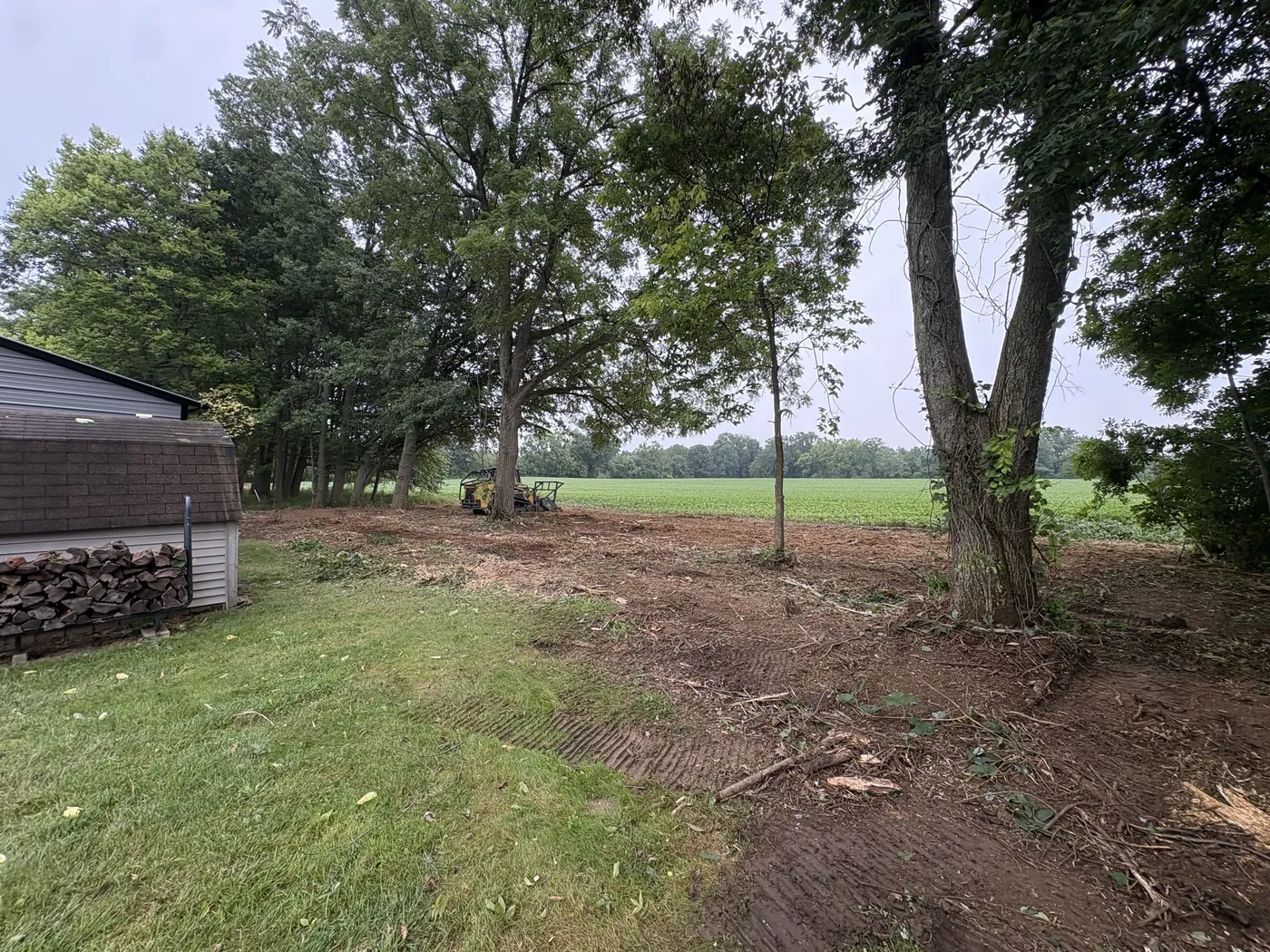
Late summer through winter is prime clearing season. Frozen or dry ground carries the machine cleanly. Our tracked mulcher grinds brush, briars and saplings up to about 6 inches into wood chips where they grew. Nothing is burned, piled or hauled off the property.
Along a fence that is staying, the crew cuts the growth off the wire by hand with chainsaws. Where the fence is coming out anyway, the mulcher runs the row. Our fence line clearing opens those corners so a mower can reach the hemlock in spring.
Come April, our brush hog can take on mowing overgrown field edges in the window between bolt and bloom. Expect a second pass for the resprouts. For a sense of price, see what brush hogging costs in Ohio.
We cannot promise a stand is gone in one season. OSU says poison hemlock is too widespread to be eradicated from Ohio, so the goal is control, year after year.
If poison hemlock is spreading along your fence rows or pasture, ask us for a free written estimate. We look at the ground on site, then put the price and timeline in writing. We work up to 75 miles from Mansfield, and you can call or text (614) 359-8762.